
On the gendered nature of (types of) hobbies
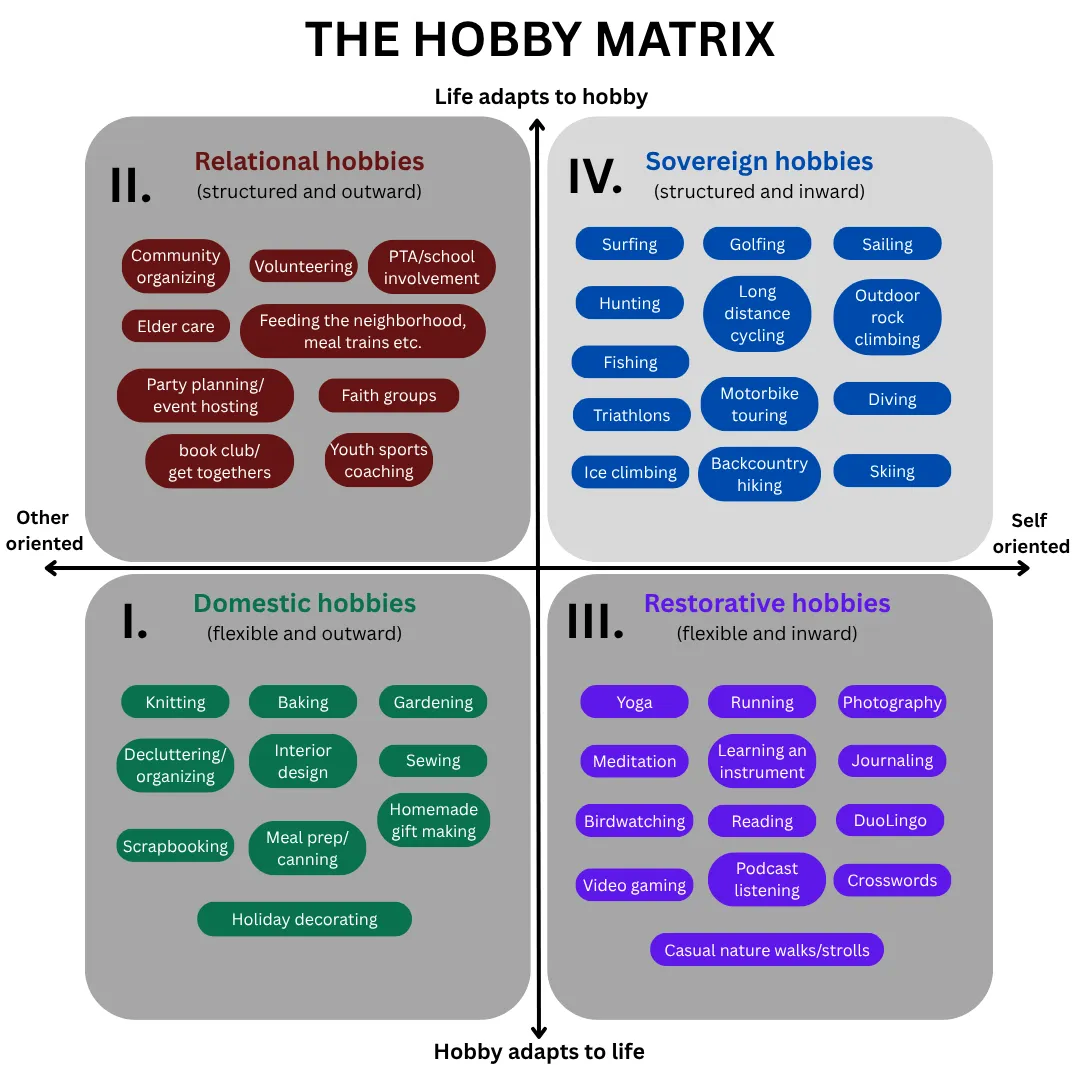
This is an interesting look at the gendered nature of hobbies, how they’re coded, and how people treat them as provisional or non-negotiable. I’ve never been a woman, and never been in a long-term relationship with anyone other than my wife, so I don’t know how this works for other people.
What I do know is that there’s at least three forces at play here: gender norms and differences, peer pressure (real/imaginary) and expectations of self. The important thing is to talk about them, and I appreciate this post as opening up space to do that.
On one axis is a simple question: who does the hobby primarily serve? Some hobbies benefit others or the household — they produce something useful or supportive, something that flows outward. Others revolve around relationships and social connection. And some hobbies exist purely for the person doing them, serving no one but herself.
On the other axis is a less obvious question: who adapts to whom? Does the hobby fit itself around life, squeezing into whatever time is available? Or does life rearrange itself around the hobby, moving other things aside to make room?
[…]
What’s happening is not simply that men choose different hobbies. It is that men treat their hobbies — whatever they are — as non-negotiables, while women treat theirs as provisional. Men bring an entitlement to leisure that operates almost independently of what the activity is. Women bring a posture of permission-seeking and when they push back, as I did, they are made to feel they are asking for something extraordinary rather than basic consideration. The result over time is a gravitational pull: men drift upward toward the fourth sovereign quadrant regardless of what their hobby is. Women’s participation in sovereign hobbies get pull downward towards the elective.
Source: Astrid