
The system can generate options. It cannot supply ownership.
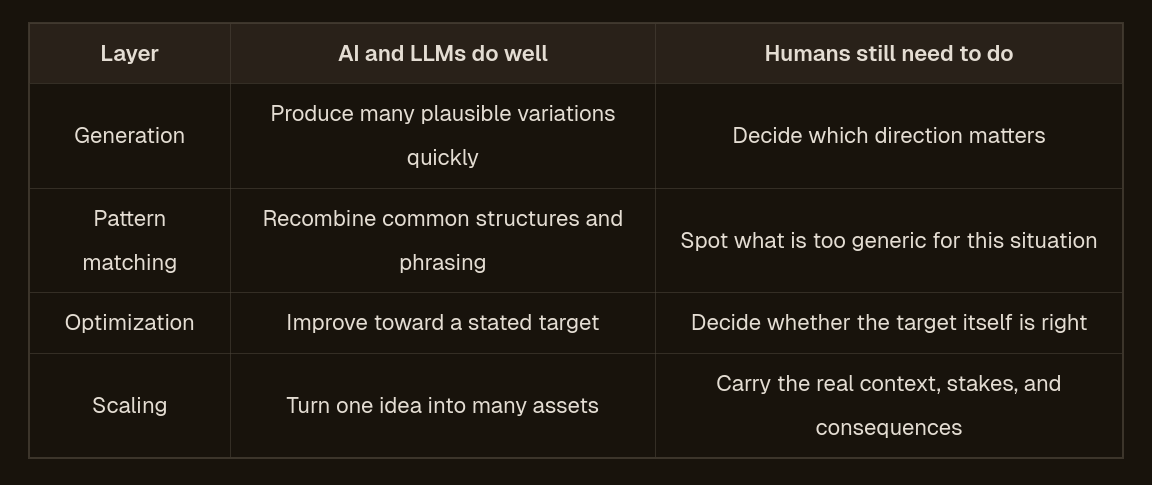
The above table is included in a fantastic article by Raj Nandan Sharma entitled Good Taste the Only Real Moat Left. He offers a nuanced view of working with LLMs, arguing that, yes, of course there is the lazy, ‘slop’ version of AI that involves what he calls “passive selection”. But what’s much more interesting valuable and value is active shaping.
There is a strong version of the “taste matters” argument that quietly pushes humans into a narrow role. In that version, AI generates many outputs and the human stands at the end of the pipeline selecting the best one.
That is a useful role, but it is also too small.
Historically, important work did not emerge from detached selection alone. It emerged from co-creation under constraint. Builders argued with reality, with collaborators, with budgets, with materials, with timelines, and with the consequences of getting things wrong.
That friction matters. It is where depth comes from.
Once you see that, the risk becomes clearer: if human value is reduced to curation, the human becomes a discriminator in a mostly machine-driven loop.
The analogy to machine learning is imperfect but useful. In generative adversarial setups, the discriminator exists to help the generator improve. Once the generator is good enough, the discriminator is not the part that ships.
The warning is not that taste has no value. It does. The warning is that taste without authorship, stake, or construction can become a narrow and eventually fragile role.
Source: Raj Nandan Sharma