
How to avoid your white collar turning blue: brilliance, influence, and relationships
The opening of this piece by Anu Atluru, which I’ve quoted below, is one of the clearest explanations of the shift that’s happening in so-called “white-collar” work at the moment. Their explanation of luxury workers' rights is spot-on.
AUTONOMY. CREATIVE OWNERSHIP. A SEAT AT THE TABLE. The right to say no, not like that, or not right now. Flexible schedules. Remote work. A title that keeps getting better. The expectation that your opinion shapes direction. The expectation that your resources scale with seniority.
These are among what I call luxury workers’ rights. They sit on top of human rights, civil rights, and workers’ rights. They’re the terms of a job meant to make work feel more meaningful and make you feel more valued. We typically associate them with white collar work and view them as moral principles, but they’ve always been a form of compensation for the scarcity of cognitive labor.
White collar work as we’ve known it is cognitive labor with a personhood premium—autonomy over the work itself and value attached to the person doing it. Cheap capital and high margins made it easy for companies who needed human intelligence to pay these premiums. Software’s surplus has been subsidizing our ego-scaffolding. But we’re facing the big shift now.
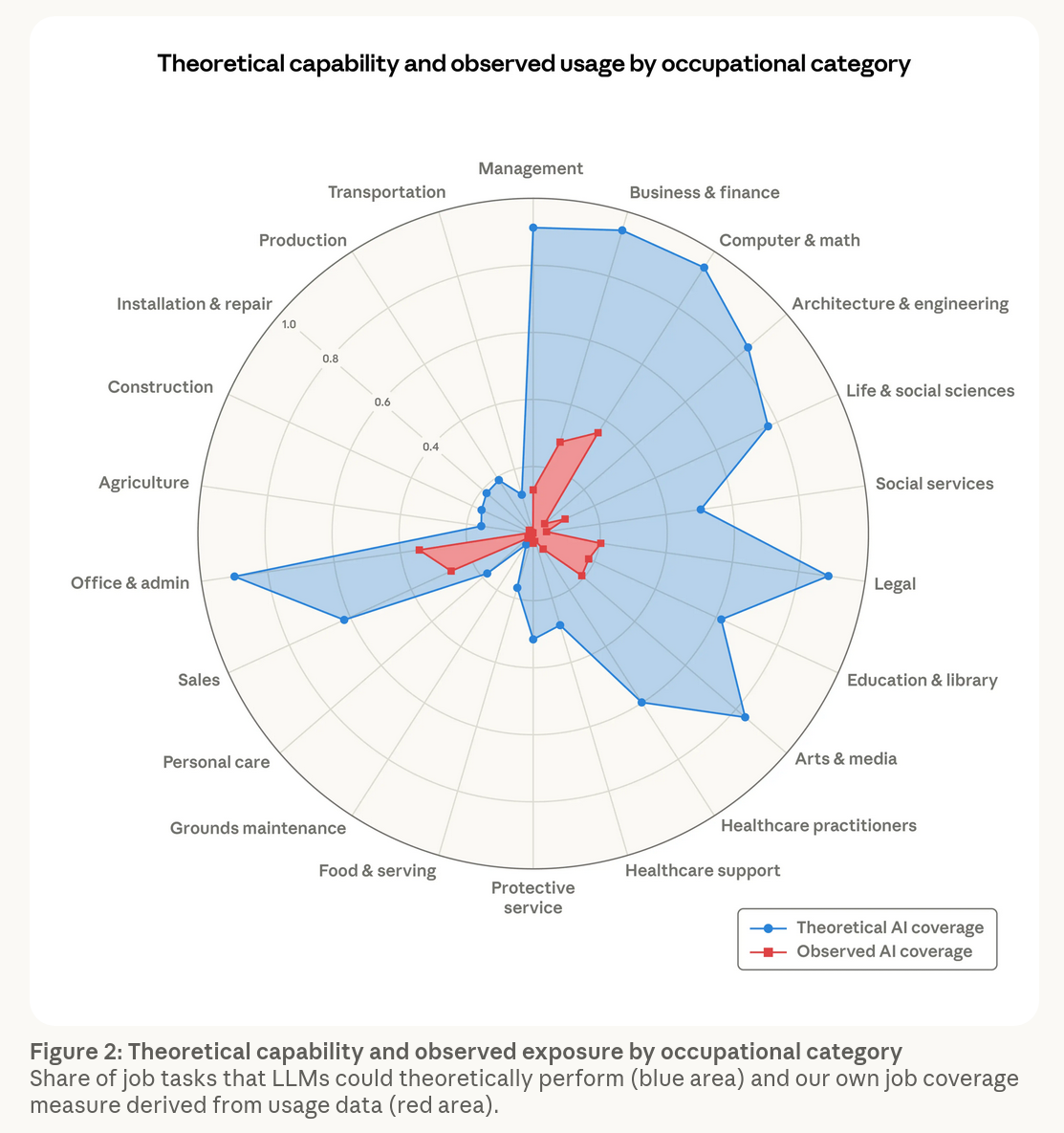
The early narrative was that AI would kill blue collar jobs first, but it turns out the real world is full of friction, and in the meantime, AI got a lot better at thinking. So it’s white collar work that’s exposed. AI is making intelligence abundant, and when the scarcity of anything drops, the premiums drop with it.
If you strip white collar jobs of their luxury rights, the line between blue and white collar gets a lot thinner. The professional laptop class is staring down its biggest reshaping and identity crisis since industrialization.
After suggesting that a return to the apprenticeship model might be in order for junior professionals, Atluru turns to what that means for the rest of us. How do we avoid being fired and re-hired with blue collar conditions?
MAKE YOURSELF SCARCE AGAIN. If we are indeed headed this direction, and you still want the luxury rights and compensation and glory, the answer is in the mechanism itself. The premium was always tied to scarcity. AI compressed it. So the way back is to go where you’re still scarce—or become something that can’t be compressed again.
What makes you scarce?
BRILLIANCE — You’re so good at something or so rare in your combination of skills (scientific, technical, creative, strategic) that you can’t be scoped into a trade. Your taste, voice, and judgment alone are a strong value proposition.
INFLUENCE — You have a name, an audience, a brand that engages high-value communities. Your taste is signal and cultural influence is power. People want to be associated with you, and that affiliation arbitrage is worth the overhead.
RELATIONSHIPS — You’re the person the founder trusts, the client wants to work with, that just makes the team better, and people just want to be around.
Relatedly, it might be worth exploring the Wikipedia article on elite overproduction which is identified as a cause of social instability.
Source: Working Theorys
Image: Anthropic