
Microcast #079 - information environments
This week's microcast is about information environments, the difference between technical and 'people' skills, and sharing your experience.
Show notes
Friday flowerings
Did you see these things this week?
- Happy 25th year, blogging. You’ve grown up, but social media is still having a brawl (The Guardian) — "The furore over social media and its impact on democracy has obscured the fact that the blogosphere not only continues to exist, but also to fulfil many of the functions of a functioning public sphere. And it’s massive. One source, for example, estimates that more than 409 million people view more than 20bn blog pages each month and that users post 70m new posts and 77m new comments each month. Another source claims that of the 1.7 bn websites in the world, about 500m are blogs. And Wordpress.com alone hosts blogs in 120 languages, 71% of them in English."
- Emmanuel Macron Wants to Scan Your Face (The Washington Post) — "President Emmanuel Macron’s administration is set to be the first in Europe to use facial recognition when providing citizens with a secure digital identity for accessing more than 500 public services online... The roll-out is tainted by opposition from France’s data regulator, which argues the electronic ID breaches European Union rules on consent – one of the building blocks of the bloc’s General Data Protection Regulation laws – by forcing everyone signing up to the service to use the facial recognition, whether they like it or not."
- This is your phone on feminism (The Conversationalist) — "Our devices are basically gaslighting us. They tell us they work for and care about us, and if we just treat them right then we can learn to trust them. But all the evidence shows the opposite is true. This cognitive dissonance confuses and paralyses us. And look around. Everyone has a smartphone. So it’s probably not so bad, and anyway, that’s just how things work. Right?"
- Google’s auto-delete tools are practically worthless for privacy (Fast Company) — "In reality, these auto-delete tools accomplish little for users, even as they generate positive PR for Google. Experts say that by the time three months rolls around, Google has already extracted nearly all the potential value from users’ data, and from an advertising standpoint, data becomes practically worthless when it’s more than a few months old."
- Audrey Watters (Uses This) — "For me, the ideal set-up is much less about the hardware or software I am using. It's about the ideas that I'm thinking through and whether or not I can sort them out and shape them up in ways that make for a good piece of writing. Ideally, that does require some comfort -- a space for sustained concentration. (I know better than to require an ideal set up in order to write. I'd never get anything done.)"
- Computer Files Are Going Extinct (OneZero) — "Files are skeuomorphic. That’s a fancy word that just means they’re a digital concept that mirrors a physical item. A Word document, for example, is like a piece of paper, sitting on your desk(top). A JPEG is like a painting, and so on. They each have a little icon that looks like the physical thing they represent. A pile of paper, a picture frame, a manila folder. It’s kind of charming really."
- Why Technologists Fail to Think of Moderation as a Virtue and Other Stories About AI (The LA Review of Books) — "Speculative fiction about AI can move us to think outside the well-trodden clichés — especially when it considers how technologies concretely impact human lives — through the influence of supersized mediators, like governments and corporations."
- Inside Mozilla’s 18-month effort to market without Facebook (Digiday) — "The decision to focus on data privacy in marketing the Mozilla brand came from research conducted by the company four years ago into the rise of consumers who make values-based decisions on not only what they purchase but where they spend their time."
- Core human values not eyeballs (Cubic Garden) — "Theres so much more to do, but the aims are high and important for not just the BBC, but all public service entities around the world. Measuring the impact and quality on peoples lives beyond the shallow meaningless metrics for public service is critical."
Image: The why is often invisible via Jessica Hagy's Indexed
Microcast #078 — Values-based organisations
I've decided to post these microcasts, which I previously made available only through Patreon, here instead.
Microcasts focus on what I've been up to and thinking about, and also provide a way to answer questions from supporters and other readers/listeners!
This microcast covers ethics in decision-making for technology companies and (related!) some recent purchases I've made.
Show notes
- Blood money is fine with us, says GitLab: Vetting non-evil customers is 'time consuming, potentially distracting' (The Register)
- Revealed: Google made large contributions to climate change deniers (The Guardian)
- Lenovo X270 (Wikipedia)
- Debian Linux
- Asus VivoMini (Wikipedia)
I am not fond of expecting catastrophes, but there are cracks in the universe
So said Sydney Smith. Let's talk about surveillance. Let's talk about surveillance capitalism and surveillance humanitarianism. But first, let's talk about machine learning and algorithms; in other words, let's talk about what happens after all of that data is collected.
Writing in The Guardian, Sarah Marsh investigates local councils using "automated guidance systems" in an attempt to save money.
The systems are being deployed to provide automated guidance on benefit claims, prevent child abuse and allocate school places. But concerns have been raised about privacy and data security, the ability of council officials to understand how some of the systems work, and the difficulty for citizens in challenging automated decisions.
Sarah Marsh
The trouble is, they're not particularly effective:
It has emerged North Tyneside council has dropped TransUnion, whose system it used to check housing and council tax benefit claims. Welfare payments to an unknown number of people were wrongly delayed when the computer’s “predictive analytics” erroneously identified low-risk claims as high risk
Meanwhile, Hackney council in east London has dropped Xantura, another company, from a project to predict child abuse and intervene before it happens, saying it did not deliver the expected benefits. And Sunderland city council has not renewed a £4.5m data analytics contract for an “intelligence hub” provided by Palantir.
Sarah Marsh
When I was at Mozilla there were a number of colleagues there who had worked on the OFA (Obama For America) campaign. I remember one of them, a DevOps guy, expressing his concern that the infrastructure being built was all well and good when there's someone 'friendly' in the White House, but what comes next.
Well, we now know what comes next, on both sides of the Atlantic, and we can't put that genie back in its bottle. Swingeing cuts by successive Conservative governments over here, coupled with the Brexit time-and-money pit means that there's no attention or cash left.
If we stop and think about things for a second, we probably wouldn't don't want to live in a world where machines make decisions for us, based on algorithms devised by nerds. As Rose Eveleth discusses in a scathing article for Vox, this stuff isn't 'inevitable' — nor does it constitute a process of 'natural selection':
Often consumers don’t have much power of selection at all. Those who run small businesses find it nearly impossible to walk away from Facebook, Instagram, Yelp, Etsy, even Amazon. Employers often mandate that their workers use certain apps or systems like Zoom, Slack, and Google Docs. “It is only the hyper-privileged who are now saying, ‘I’m not going to give my kids this,’ or, ‘I’m not on social media,’” says Rumman Chowdhury, a data scientist at Accenture. “You actually have to be so comfortable in your privilege that you can opt out of things.”
And so we’re left with a tech world claiming to be driven by our desires when those decisions aren’t ones that most consumers feel good about. There’s a growing chasm between how everyday users feel about the technology around them and how companies decide what to make. And yet, these companies say they have our best interests in mind. We can’t go back, they say. We can’t stop the “natural evolution of technology.” But the “natural evolution of technology” was never a thing to begin with, and it’s time to question what “progress” actually means.
Rose Eveleth
I suppose the thing that concerns me the most is people in dire need being subject to impersonal technology for vital and life-saving aid.
For example, Mark Latonero, writing in The New York Times, talks about the growing dangers around what he calls 'surveillance humanitarianism':
By surveillance humanitarianism, I mean the enormous data collection systems deployed by aid organizations that inadvertently increase the vulnerability of people in urgent need.
Despite the best intentions, the decision to deploy technology like biometrics is built on a number of unproven assumptions, such as, technology solutions can fix deeply embedded political problems. And that auditing for fraud requires entire populations to be tracked using their personal data. And that experimental technologies will work as planned in a chaotic conflict setting. And last, that the ethics of consent don’t apply for people who are starving.
Mark Latonero
It's easy to think that this is an emergency, so we should just do whatever is necessary. But Latonero explains the risks, arguing that the risk is shifted to a later time:
If an individual or group’s data is compromised or leaked to a warring faction, it could result in violent retribution for those perceived to be on the wrong side of the conflict. When I spoke with officials providing medical aid to Syrian refugees in Greece, they were so concerned that the Syrian military might hack into their database that they simply treated patients without collecting any personal data. The fact that the Houthis are vying for access to civilian data only elevates the risk of collecting and storing biometrics in the first place.
Mark Latonero
There was a rather startling article in last weekend's newspaper, which I've found online. Hannah Devlin, again writing in The Guardian (which is a good source of information for those concerned with surveillance) writes about a perfect storm of social media and improved processing speeds:
[I]n the past three years, the performance of facial recognition has stepped up dramatically. Independent tests by the US National Institute of Standards and Technology (Nist) found the failure rate for finding a target picture in a database of 12m faces had dropped from 5% in 2010 to 0.1% this year.
The rapid acceleration is thanks, in part, to the goldmine of face images that have been uploaded to Instagram, Facebook, LinkedIn and captioned news articles in the past decade. At one time, scientists would create bespoke databases by laboriously photographing hundreds of volunteers at different angles, in different lighting conditions. By 2016, Microsoft had published a dataset, MS Celeb, with 10m face images of 100,000 people harvested from search engines – they included celebrities, broadcasters, business people and anyone with multiple tagged pictures that had been uploaded under a Creative Commons licence, allowing them to be used for research. The dataset was quietly deleted in June, after it emerged that it may have aided the development of software used by the Chinese state to control its Uighur population.
In parallel, hardware companies have developed a new generation of powerful processing chips, called Graphics Processing Units (GPUs), uniquely adapted to crunch through a colossal number of calculations every second. The combination of big data and GPUs paved the way for an entirely new approach to facial recognition, called deep learning, which is powering a wider AI revolution.
Hannah Devlin
Those of you who have read this far and are expecting some big reveal are going to be disappointed. I don't have any 'answers' to these problems. I guess I've been guilty, like many of us have, of the kind of 'privacy nihilism' mentioned by Ian Bogost in The Atlantic:
Online services are only accelerating the reach and impact of data-intelligence practices that stretch back decades. They have collected your personal data, with and without your permission, from employers, public records, purchases, banking activity, educational history, and hundreds more sources. They have connected it, recombined it, bought it, and sold it. Processed foods look wholesome compared to your processed data, scattered to the winds of a thousand databases. Everything you have done has been recorded, munged, and spat back at you to benefit sellers, advertisers, and the brokers who service them. It has been for a long time, and it’s not going to stop. The age of privacy nihilism is here, and it’s time to face the dark hollow of its pervasive void.
Ian Bogost
The only forces that we have to stop this are collective action, and governmental action. My concern is that we don't have the digital savvy to do the former, and there's definitely the lack of will in respect of the latter. Troubling times.
Friday fawnings
On this week's rollercoaster journey, I came across these nuggets:
- Renata Ávila: “The Internet of creation disappeared. Now we have the Internet of surveillance and control” (CCCB Lab) — "This lawyer and activist talks with a global perspective about the movements that the power of “digital colonialism” is weaving. Her arguments are essential for preventing ourselves from being crushed by the technological world, from being carried away by the current of ephemeral divertemento. For being fully aware that, as individuals, our battle is not lost, but that we can control the use of our data, refuse to give away our facial recognition or demand that the privacy laws that protect us are obeyed."
- Everything Is Private Equity Now (Bloomberg) — "The basic idea is a little like house flipping: Take over a company that’s relatively cheap and spruce it up to make it more attractive to other buyers so you can sell it at a profit in a few years. The target might be a struggling public company or a small private business that can be combined—or “rolled up”—with others in the same industry."
- Forget STEM, We Need MESH (Our Human Family) — "I would suggest a renewed focus on MESH education, which stands for Media Literacy, Ethics, Sociology, and History. Because if these are not given equal attention, we could end up with incredibly bright and technically proficient people who lack all capacity for democratic citizenship."
- Connecting the curious (Harold Jarche) — "If we want to change the world, be curious. If we want to make the world a better place, promote curiosity in all aspects of learning and work. There are still a good number of curious people of all ages working in creative spaces or building communities around common interests. We need to connect them."
- Twitter: No, really, we're very sorry we sold your security info for a boatload of cash (The Register) — "The social networking giant on Tuesday admitted to an "error" that let advertisers have access to the private information customers had given Twitter in order to place additional security protections on their accounts."
- Digital tools interrupt workers 14 times a day (CIO Dive) — "The constant chime of digital workplace tools including email, instant messaging or collaboration software interrupts knowledge workers 13.9 times on an average day, according to a survey of 3,750 global workers from Workfront."
- Book review – Curriculum: Athena versus the Machine (TES) — "Despite the hope that the book is a cure for our educational malaise, Curriculum is a morbid symptom of the current political and intellectual climate in English education."
- Fight for the planet: Building an open platform and open culture at Greenpeace (Opensource.com) — "Being as open as we can, pushing the boundaries of what it means to work openly, doesn't just impact our work. It impacts our identity."
- Psychodata (Code Acts in Education) — "Social-emotional learning sounds like a progressive, child-centred agenda, but behind the scenes it’s primarily concerned with new forms of child measurement."
Image via xkcd
People will come to adore the technologies that undo their capacities to think
So said Neil Postman (via Jay Springett). Jay is one of a small number of people who's work I find particularly thoughtful and challenging.
Another is Venkatesh Rao, who last week referenced a Twitter thread he posted earlier this year. It's awkward to and quote the pertinent parts of such things, but I'll give it a try:
Megatrend conclusion: if you do not build a second brain or go offline, you will BECOME the second brain.
[...]
Basically, there's no way to actually handle the volume of information and news that all of us appear to be handling right now. Which means we are getting augmented cognition resources from somewhere. The default place is "social" media.
[...]
What those of us who are here are doing is making a deal with the devil (or an angel): in return for being 1-2 years ahead of curve, we play 2nd brain to a shared first brain. We've ceded control of executive attention not to evil companies, but… an emergent oracular brain.
[...]
I called it playing your part in the Global Social Computer in the Cloud (GSCITC).
[...]
Central trade-off in managing your participation in GSCITC is: The more you attempt to consciously curate your participation rather than letting it set your priorities, the less oracular power you get in return.
Venkatesh Rao
He reckons that being fully immersed in the firehose of social media is somewhat like reading the tea leaves or understanding the runes. You have to 'go with the flow'.
Rao uses the example of the very Twitter thread he's making. Constructing it that way versus, for example, writing a blog post or newsletter means he is in full-on 'gonzo mode' versus what he calls (after Henry David Thoreau) 'Waldenponding'.
I have been generally very unimpressed with the work people seem to generate when they go waldenponding to work on supposedly important things. The comparable people who stay more plugged in seem to produce better work.
My kindest reading of people who retreat so far it actually compromises their work is that it is a mental health preservation move because they can't handle the optimum GSCITC immersion for their project. Their work could be improved if they had the stomach for more gonzo-nausea.
My harshest reading is that they're narcissistic snowflakes who overvalue their work simply because they did it.
Venkatesh Rao
Well, perhaps. But as someone who has attempted to drink from that firehouse for over a decade, I think the time comes when you realise something else. Who's setting the agenda here? It's not 'no-one', but neither is it any one person in particular. Rather the whole structure of what can happen within such a network depends on decisions made other than you.
For example, Dan Hon, pointed (in a supporter-only newsletter) to an article by Louise Matsakis in WIRED that explains that the social network TikTok not only doesn't add timestamps to user-generated content, but actively blocks the clock on your smartphone. These design decisions affect what can and can't happen, and also the kinds of things that do end up happening.
Writing in The Guardian, Leah McLaren writes about being part of the last generation to really remember life before the internet.
In this age of uncertainty, predictions have lost value, but here’s an irrefutable one: quite soon, no person on earth will remember what the world was like before the internet. There will be records, of course (stored in the intangibly limitless archive of the cloud), but the actual lived experience of what it was like to think and feel and be human before the emergence of big data will be gone. When that happens, what will be lost?
Leah McLaren
McLaren is evidently a few years older than me, as I've been online since I was about 15. However, I definitely reflect on a regular basis about what being hyper-connected does to my sense of self. She cites a recent study published in the official journal of the World Psychiatric Association. Part of the conclusion of that study reads:
As digital technologies become increasingly integrated with everyday life, the Internet is becoming highly proficient at capturing our attention, while producing a global shift in how people gather information, and connect with one another. In this review, we found emerging support for several hypotheses regarding the pathways through which the Internet is influencing our brains and cognitive processes, particularly with regards to: a) the multi‐faceted stream of incoming information encouraging us to engage in attentional‐switching and “multi‐tasking” , rather than sustained focus; b) the ubiquitous and rapid access to online factual information outcompeting previous transactive systems, and potentially even internal memory processes; c) the online social world paralleling “real world” cognitive processes, and becoming meshed with our offline sociality, introducing the possibility for the special properties of social media to impact on “real life” in unforeseen ways.
Firth, J., et al. (2019). The “online brain”: how the Internet may be changing our cognition. World Psychiatry, 18: 119-129.
In her Guardian article, McLaren cites the main author, Dr Joseph Firth:
“The problem with the internet,” Firth explained, “is that our brains seem to quickly figure out it’s there – and outsource.” This would be fine if we could rely on the internet for information the same way we rely on, say, the British Library. But what happens when we subconsciously outsource a complex cognitive function to an unreliable online world manipulated by capitalist interests and agents of distortion? “What happens to children born in a world where transactive memory is no longer as widely exercised as a cognitive function?” he asked.
Leah McLaren
I think this is the problem, isn't it? I've got no issue with having an 'outboard brain' where I store things that I want to look up instead of remember. It's also insanely useful to have a method by which the world can join together in a form of 'hive mind'.
What is problematic is when this 'hive mind' (in the form of social media) is controlled by people and organisations whose interests are orthogonal to our own.
In that situation, there are three things we can do. The first is to seek out forms of nascent 'hive mind'-like spaces which are not controlled by people focused on the problematic concept of 'shareholder value'. Like Mastodon, for example, and other decentralised social networks.
The second is to spend time finding out the voices to which you want to pay particular attention. The chances are that they won't only write down their thoughts via social networks. They are likely to have newsletters, blogs, and even podcasts.
Third, an apologies for the metaphor, but with such massive information consumption the chances are that we can become 'constipated'. So if we don't want that to happen, if we don't want to go on an 'information diet', then we need to ensure a better throughput. One of the best things I've done is have a disciplined approach to writing (here on Thought Shrapnel, and elsewhere) about the things I've read and found interesting. That's one way to extract the nutrients.
I'd love your thoughts on this. Do you agree with the above? What strategies do you have in place?
Friday flexitarianism
Check these links out and tell me which one you like best:
- The radical combination of degrowth and basic income (openDemocracy) — "One of the things you hear whenever you talk about degrowth is that, if the economy doesn't grow, people are going to be without jobs, people will go hungry, and no one wants that. Rich countries might be able to afford slowing down their economies, but not poorer ones. You hear this argument mostly in countries from the Global South, like my own. This misses the point. Degrowth is a critique of our dependency on work. This idea that people have to work to stay alive, and thus the economy needs to keep growing for the sake of keeping people working."
- The hypersane are among us, if only we are prepared to look (Aeon) — "It is not just that the ‘sane’ are irrational but that they lack scope and range, as though they’ve grown into the prisoners of their arbitrary lives, locked up in their own dark and narrow subjectivity. Unable to take leave of their selves, they hardly look around them, barely see beauty and possibility, rarely contemplate the bigger picture – and all, ultimately, for fear of losing their selves, of breaking down, of going mad, using one form of extreme subjectivity to defend against another, as life – mysterious, magical life – slips through their fingers."
- "The Tragedy of the Commons": how ecofascism was smuggled into mainstream thought (BoingBoing) — "We are reaching a "peak indifference" tipping point in the climate debate, where it's no longer possible to deny the reality of the climate crisis. I think that many of us assumed that when that happened, we'd see a surge of support for climate justice, the diversion of resources from wealth extraction for the super-rich to climate remediation and defense centered on the public good. But that expectation overestimated the extent to which climate denial was motivated by mere greed."
- What Would It Take to Shut Down the Entire Internet? (Gizmodo) "One imaginative stumbling block, in playing out the implications of [this] scenario, was how something like that could happen in the first place. And so—without advocating any of the methods described below, or strongly suggesting that hundreds or thousands of like-minded heroes band together to take this sucker down once and for all—...we’ve asked a number of cybersecurity experts how exactly one would go about shutting down the entire internet."
- Earning, spending, saving: The currency of influence in open source (Opensource.com) — "Even though you can't buy it, influence behaves like a form of virtual currency in an open source community: a scarce resource, always needed, but also always in short supply. One must earn it through contributions to an open source project or community. In contrast to monetary currency, however, influence is not transferable. You must earn it for yourself. You can neither give nor receive it as a gift."
- The Art of Topophilia: 7 Ways to Love the Place You Live (Art of Manliness) — "It’s not only possible to kindle this kind of topophilic love affair with “sexier” places chock full of well-hyped advantages, but also with so-called undesirable communities that aren’t on the cultural radar. Just as people who may initially appear lowly and unappealing, but have warm and welcoming personalities, come to seem more attractive the more we get to know them, so too can sleepier, less vaunted locales."
- A Like Can’t Go Anywhere, But a Compliment Can Go a Long Way (Frank Chimero) — "Passive positivity isn’t enough; active positivity is needed to counterbalance whatever sort of collective conversations and attention we point at social media. Otherwise, we are left with the skewed, inaccurate, and dangerous nature of what’s been built: an environment where most positivity is small, vague, and immobile, and negativity is large, precise, and spreadable."
- EU recognises "right to repair" in push to make appliances last longer (Dezeen) — "Not included in the EU right to repair rules are devices such as smart phones and laptops, whose irreplaceable batteries and performance-hampering software updates are most often accused of encouraging throwaway culture."
- I'm a Psychotherapist Who Sets 30-Day Challenges Instead of Long-Term Goals. Here's Why (Inc.) — "Studies show our brains view time according to either "now deadlines" or "someday deadlines." And "now deadlines" often fall within this calendar month."
Image by Yung-sen Wu (via The Atlantic)
Technology is the name we give to stuff that doesn't work properly yet
So said my namesake Douglas Adams. In fact, he said lots of wise things about technology, most of them too long to serve as a title.
I'm in a weird place, emotionally, at the moment, but sometimes this can be a good thing. Being taken out of your usual 'autopilot' can be a useful way to see things differently. So I'm going to take this opportunity to share three things that, to be honest, make me a bit concerned about the next few years...
Attempts to put microphones everywhere
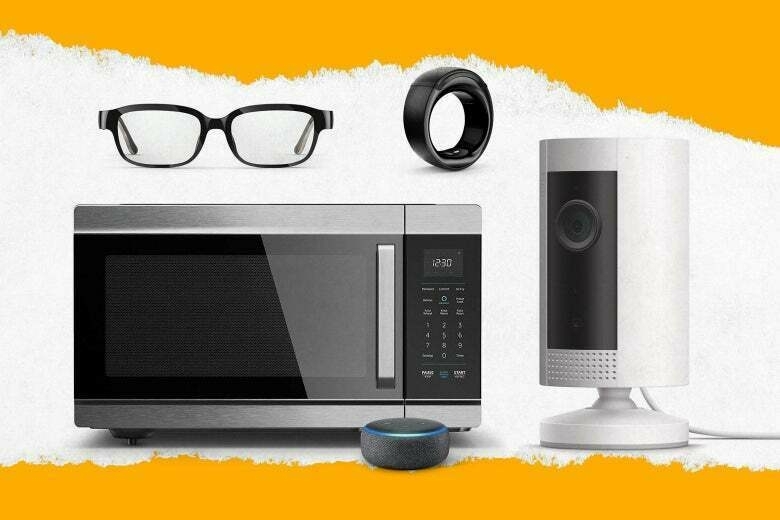
In an article for Slate, Shannon Palus ranks all of Amazon's new products by 'creepiness'. The Echo Frames are, in her words:
A microphone that stays on your person all day and doesn’t look like anything resembling a microphone, nor follows any established social codes for wearable microphones? How is anyone around you supposed to have any idea that you are wearing a microphone?
Shannon Palus
When we're not talking about weapons of mass destruction, it's not the tech that concerns me, but the context in which the tech is used. As Palus points out, how are you going to be able to have a 'quiet word' with anyone wearing glasses ever again?
It's not just Amazon, of course. Google and Facebook are at it, too.
Full-body deepfakes
With the exception, perhaps, of populist politicians, I don't think we're ready for a post-truth society. Check out the video above, which shows Chinese technology that allows for 'full body deepfakes'.
The video is embedded, along with a couple of others in an article for Fast Company by DJ Pangburn, who also notes that AI is learning human body movements from videos. Not only will you be able to prank your friends by showing them a convincing video of your ability to do 100 pull-ups, but the fake news it engenders will mean we can't trust anything any more.
Neuromarketing
If you clicked on the 'super-secret link' in Sunday's newsletter, you will have come across STEALING UR FEELINGS which is nothing short of incredible. As powerful as it is in showing you the kind of data that organisations have on us, it's the tip of the iceberg.
Kaveh Waddell, in an article for Axios, explains that brains are the last frontier for privacy:
"The sort of future we're looking ahead toward is a world where our neural data — which we don't even have access to — could be used" against us, says Tim Brown, a researcher at the University of Washington Center for Neurotechnology.
Kaveh Waddell
This would lead to 'neuromarketing', with advertisers knowing what triggers and influences you better than you know yourself. Also, it will no doubt be used for discriminatory purposes and, because it's coming directly from your brainwaves, short of literally wearing a tinfoil hat, there's nothing much you can do.
So there we are. Am I being too fearful here?
Friday fluctuations
Have a quick skim through these links that I came across this week and found interesting:
- Overrated: Ludwig Wittgenstein (Standpoint) — "Wittgenstein’s reputation for genius did not depend on incomprehensibility alone. He was also “tortured”, rude and unreliable. He had an intense gaze. He spent months in cold places like Norway to isolate himself. He temporarily quit philosophy, because he believed that he had solved all its problems in his 1922 Tractatus Logico-Philosophicus, and worked as a gardener. He gave away his family fortune. And, of course, he was Austrian, as so many of the best geniuses are."
- EdTech Resistance (Ben Williamson) — "We should not and cannot ignore these tensions and challenges. They are early signals of resistance ahead for edtech which need to be engaged with before they turn to public outrage. By paying attention to and acting on edtech resistances it may be possible to create education systems, curricula and practices that are fair and trustworthy. It is important not to allow edtech resistance to metamorphose into resistance to education itself."
- The Guardian view on machine learning: a computer cleverer than you? (The Guardian) — "The promise of AI is that it will imbue machines with the ability to spot patterns from data, and make decisions faster and better than humans do. What happens if they make worse decisions faster? Governments need to pause and take stock of the societal repercussions of allowing machines over a few decades to replicate human skills that have been evolving for millions of years."
- A nerdocratic oath (Scott Aaronson) — "I will never allow anyone else to make me a cog. I will never do what is stupid or horrible because “that’s what the regulations say” or “that’s what my supervisor said,” and then sleep soundly at night. I’ll never do my part for a project unless I’m satisfied that the project’s broader goals are, at worst, morally neutral. There’s no one on earth who gets to say: “I just solve technical problems. Moral implications are outside my scope”."
- Privacy is power (Aeon) — "The power that comes about as a result of knowing personal details about someone is a very particular kind of power. Like economic power and political power, privacy power is a distinct type of power, but it also allows those who hold it the possibility of transforming it into economic, political and other kinds of power. Power over others’ privacy is the quintessential kind of power in the digital age."
- The Symmetry and Chaos of the World's Megacities (WIRED) — "Koopmans manages to create fresh-looking images by finding unique vantage points, often by scouting his locations on Google Earth. As a rule, he tries to get as high as he can—one of his favorite tricks is talking local work crews into letting him shoot from the cockpit of a construction crane."
- Green cities of the future - what we can expect in 2050 (RNZ) — "In their lush vision of the future, a hyperloop monorail races past in the foreground and greenery drapes the sides of skyscrapers that house communal gardens and vertical farms."
- Wittgenstein Teaches Elementary School (Existential Comics) — "And I'll have you all know, there is no crying in predicate logic."
- Ask Yourself These 5 Questions to Inspire a More Meaningful Career Move (Inc.) — "Introspection on the right things can lead to the life you want."
Image from Do It Yurtself
It’s not a revolution if nobody loses
Thanks to Clay Shirky for today's title. It's true, isn't it? You can't claim something to be a true revolution unless someone, some organisation, or some group of people loses.
I'm happy to say that it's the turn of some older white men to be losing right now, and particularly delighted that those who have spent decades abusing and repressing people are getting their comeuppance.
Enough has been written about Epstein and the fallout from it. You can read about comments made by Richard Stallman, founder of the Free Software Foundation, in this Washington Post article. I've only met RMS (as he's known) in person once, at the Indie Tech Summit five years ago, but it wasn't a great experience. While I'm willing to cut visionary people some slack, he mostly acted like a jerk.
RMS is a revered figure in Free Software circles and it's actually quite difficult not to agree with his stance on many political and technological matters. That being said, he deserves everything he gets though for the comments he made about child abuse, for the way he's treated women for the past few decades, and his dictator-like approach to software projects.
In an article for WIRED entitled Richard Stallman’s Exit Heralds a New Era in Tech, Noam Cohen writes that we're entering a new age. I certainly hope so.
This is a lesson we are fast learning about freedom as it promoted by the tech world. It is not about ensuring that everyone can express their views and feelings. Freedom, in this telling, is about exclusion. The freedom to drive others away. And, until recently, freedom from consequences.
After 40 years of excluding those who didn’t serve his purposes, however, Stallman finds himself excluded by his peers. Freedom.
Maybe freedom, defined in this crude, top-down way, isn’t the be-all, end-all. Creating a vibrant inclusive community, it turns out, is as important to a software project as a coding breakthrough. Or, to put it in more familiar terms—driving away women, investing your hopes in a single, unassailable leader is a critical bug. The best patch will be to start a movement that is respectful, inclusive, and democratic.
Noam Cohen
One of the things that the next leaders of the Free Software Movement will have to address is how to take practical steps to guarantee our basic freedoms in a world where Big Tech provides surveillance to ever-more-powerful governments.
Cory Doctorow is an obvious person to look to in this regard. He has a history of understanding what's going on and writing about it in ways that people understand. In an article for The Globe and Mail, Doctorow notes that a decline in trust of political systems and experts more generally isn't because people are more gullible:
40 years of rising inequality and industry consolidation have turned our truth-seeking exercises into auctions, in which lawmakers, regulators and administrators are beholden to a small cohort of increasingly wealthy people who hold their financial and career futures in their hands.
[...]
To be in a world where the truth is up for auction is to be set adrift from rationality. No one is qualified to assess all the intensely technical truths required for survival: even if you can master media literacy and sort reputable scientific journals from junk pay-for-play ones; even if you can acquire the statistical literacy to evaluate studies for rigour; even if you can acquire the expertise to evaluate claims about the safety of opioids, you can’t do it all over again for your city’s building code, the aviation-safety standards governing your next flight, the food-safety standards governing the dinner you just ordered.
Cory Doctorow
What's this got to do with technology, and in particular Free Software?
Big Tech is part of this problem... because they have monopolies, thanks to decades of buying nascent competitors and merging with their largest competitors, of cornering vertical markets and crushing rivals who won't sell. Big Tech means that one company is in charge of the social lives of 2.3 billion people; it means another company controls the way we answer every question it occurs to us to ask. It means that companies can assert the right to control which software your devices can run, who can fix them, and when they must be sent to a landfill.
These companies, with their tax evasion, labour abuses, cavalier attitudes toward our privacy and their completely ordinary human frailty and self-deception, are unfit to rule our lives. But no one is fit to be our ruler. We deserve technological self-determination, not a corporatized internet made up of five giant services each filled with screenshots from the other four.
Cory Doctorow
Doctorow suggests breaking up these companies to end their de facto monopolies and level the playing field.
The problem of tech monopolies is something that Stowe Boyd explored in a recent article entitled Are Platforms Commons? Citing previous precedents around railroads, Boyd has many questions, including whether successful platforms be bound with the legal principles of 'common carriers', and finishes with this:
However, just one more question for today: what if ecosystems were constructed so that they were governed by the participants, rather by the hypercapitalist strivings of the platform owners — such as Apple, Google, Amazon, Facebook — or the heavy-handed regulators? Is there a middle ground where the needs of the end user and those building, marketing, and shipping products and services can be balanced, and a fair share of the profits are distributed not just through common carrier laws but by the shared economics of a commons, and where the platform orchestrator gets a fair share, as well? We may need to shift our thinking from common carrier to commons carrier, in the near future.
Stowe Boyd
The trouble is, simply establishing a commons doesn't solve all of the problems. In fact, what tends to happen next is well known:
The tragedy of the commons is a situation in a shared-resource system where individual users, acting independently according to their own self-interest, behave contrary to the common good of all users, by depleting or spoiling that resource through their collective action.
Wikipedia
An article in The Economist outlines the usual remedies to the 'tragedy of the commons': either governmental regulation (e.g. airspace), or property rights (e.g. land). However, the article cites the work of Elinor Ostrom, a Nobel prizewinning economist, showing that another way is possible:
An exclusive focus on states and markets as ways to control the use of commons neglects a varied menagerie of institutions throughout history. The information age provides modern examples, for example Wikipedia, a free, user-edited encyclopedia. The digital age would not have dawned without the private rewards that flowed to successful entrepreneurs. But vast swathes of the web that might function well as commons have been left in the hands of rich, relatively unaccountable tech firms.
[...]
A world rich in healthy commons would of necessity be one full of distributed, overlapping institutions of community governance. Cultivating these would be less politically rewarding than privatisation, which allows governments to trade responsibility for cash. But empowering commoners could mend rents in the civic fabric and alleviate frustration with out-of-touch elites.
The Economist
I count myself as someone on the left of politics, if that's how we're measuring things today. However, I don't think we need representation at any higher level than is strictly necessary.
In a time when technology allows you, to a great extent, to represent yourself, perhaps we need ways of demonstrating how complex and multi-faceted some issues are? Perhaps we need to try 'liquid democracy':
Liquid democracy lies between direct and representative democracy. In direct democracy, participants must vote personally on all issues, while in representative democracy participants vote for representatives once in certain election cycles. Meanwhile, liquid democracy does not depend on representatives but rather on a weighted and transitory delegation of votes. Liquid democracy through elections can empower individuals to become sole interpreters of the interests of the nation. It allows for citizens to vote directly on policy issues, delegate their votes on one or multiple policy areas to delegates of their choosing, delegate votes to one or more people, delegated to them as a weighted voter, or get rid of their votes' delegations whenever they please.
WIkipedia
I think, given the state that politics is in right now, it's well worth a try. The problem, of course, is that the losers would be the political elites, the current incumbents. But, hey, it's not a revolution if nobody loses, right?
Saturday strikings
This week's roundup is going out a day later than usual, as yesterday was the Global Climate Strike and Thought Shrapnel was striking too!
Here's what I've been paying attention to this week:
- How does a computer ‘see’ gender? (Pew Research Center) — "Machine learning tools can bring substantial efficiency gains to analyzing large quantities of data, which is why we used this type of system to examine thousands of image search results in our own studies. But unlike traditional computer programs – which follow a highly prescribed set of steps to reach their conclusions – these systems make their decisions in ways that are largely hidden from public view, and highly dependent on the data used to train them. As such, they can be prone to systematic biases and can fail in ways that are difficult to understand and hard to predict in advance."
- The Communication We Share with Apes (Nautilus) — "Many primate species use gestures to communicate with others in their groups. Wild chimpanzees have been seen to use at least 66 different hand signals and movements to communicate with each other. Lifting a foot toward another chimp means “climb on me,” while stroking their mouth can mean “give me the object.” In the past, researchers have also successfully taught apes more than 100 words in sign language."
- Why degrowth is the only responsible way forward (openDemocracy) — "If we free our imagination from the liberal idea that well-being is best measured by the amount of stuff that we consume, we may discover that a good life could also be materially light. This is the idea of voluntary sufficiency. If we manage to decide collectively and democratically what is necessary and enough for a good life, then we could have plenty."
- 3 times when procrastination can be a good thing (Fast Company) — "It took Leonardo da Vinci years to finish painting the Mona Lisa. You could say the masterpiece was created by a master procrastinator. Sure, da Vinci wasn’t under a tight deadline, but his lengthy process demonstrates the idea that we need to work through a lot of bad ideas before we get down to the good ones."
- Why can’t we agree on what’s true any more? (The Guardian) — "What if, instead, we accepted the claim that all reports about the world are simply framings of one kind or another, which cannot but involve political and moral ideas about what counts as important? After all, reality becomes incoherent and overwhelming unless it is simplified and narrated in some way or other.
- A good teacher voice strikes fear into grown men (TES) — "A good teacher voice can cut glass if used with care. It can silence a class of children; it can strike fear into the hearts of grown men. A quiet, carefully placed “Excuse me”, with just the slightest emphasis on the “-se”, is more effective at stopping an argument between adults or children than any amount of reason."
- Freeing software (John Ohno) — "The only way to set software free is to unshackle it from the needs of capital. And, capital has become so dependent upon software that an independent ecosystem of anti-capitalist software, sufficiently popular, can starve it of access to the speed and violence it needs to consume ever-doubling quantities of to survive."
- Young People Are Going to Save Us All From Office Life (The New York Times) — "Today’s young workers have been called lazy and entitled. Could they, instead, be among the first to understand the proper role of work in life — and end up remaking work for everyone else?"
- Global climate strikes: Don’t say you’re sorry. We need people who can take action to TAKE ACTUAL ACTION (The Guardian) — "Brenda the civil disobedience penguin gives some handy dos and don’ts for your civil disobedience"
All is petty, inconstant, and perishable
So said Marcus Aurelius. Today's short article is about what happens after you die. We're all aware of the importance of making a will, particularly if you have dependants. But that's primarily for your analogue, offline life. What about your digital life?
In a recent TechCrunch article, Jon Evans writes:
I really wish I hadn’t had cause to write this piece, but it recently came to my attention, in an especially unfortunate way, that death in the modern era can have a complex and difficult technical aftermath. You should make a will, of course. Of course you should make a will. But many wills only dictate the disposal of your assets. What will happen to the other digital aspects of your life, when you’re gone?
Jon Evans
The article points to a template for a Digital Estate Planning Document which you can use to list all of the places that you're active. Interestingly, the suggestion is to have a 'digital executor', which makes sense as the more technical you are the more likely that other members of your family might not be able to follow your instructions.
Interestingly, the Wikipedia article on digital wills has some very specific advice of which the above-mentioned document is only a part:
- Appoint someone as online executor
- State in a formal document how profiles and accounts are handled
- Understand privacy policies
- Provide online executor list of websites and logins
- State in the will that the online executor must have a copy of the death certificate
I hadn't really thought about this, but the chances of identity theft after someone has died are as great, if not greater, as when they were alive:
An article by Magder in the newspaper The Gazette provides a reminder that identity theft can potentially continue to be a problem even after death if their information is released to the wrong people. This is why online networks and digital executors require proof of a death certificate from a family member of the deceased person in order to acquire access to accounts. There are instances when access may still be denied, because of the prevalence of false death certificates.
Wikipedia
Zooming out a bit, and thinking about this from my own perspective, it's a good idea to insist on good security practices for your nearest and dearest. Ensure they know how to use password managers and use two-factor authentication on their accounts. If they do this for themselves, they'll understand how to do it with your accounts when you're gone.
One thing it's made think about is the length of time for which I renew domain names. I tend to just renew mine (I have quite a few) on a yearly basis. But what if the worst happened? Those payment details would be declined, and my sites would be offline in a year or less.
All of this makes me think that the important thing here is to keep things as simple as possible. As I've discussed in another article, the way people remember us after we're gone is kind of important.
Most of us could, I think, divide our online life into three buckets:
- Really important to my legacy
- Kind of important
- Not important
So if, for example, I died tomorrow, the domain renewal for Thought Shrapnel lapsed next year, and a scammer took it over, that would be terrible. It's part of the reason why I still renew domains I don't use. So this would go in the 'really important to my legacy' bucket.
On the other hand, my experiments with various tools and platforms I'm less bothered about. They would probably go in the 'not important' bucket.
Then there's that awkward middle space. Things like the site for my doctoral thesis when the 'official' copy is in the Durham University e-Theses repository.
Ultimately, it's a conversation to have with those close to you. For me, it's on my mind after the death of a good friend and so something I should get to before life goes back to some version of normality. After all, figuring out someone else's digital life admin is the last thing people want when they're already dealing with grief.
Friday fermentations
I boiled the internet and this was what remained:
- I Quit Social Media for a Year and Nothing Magical Happened (Josh C. Simmons) — "A lot of social media related aspects of my life are different now – I’m not sure they’re better, they’re just different, but I can confidently say that I prefer this normal to last year’s. There’s a bit of rain with all of the sunshine. I don’t see myself ever going back to social media. I don’t see the point of it, and after leaving for a while, and getting a good outside look, it seems like an abusive relationship – millions of workers generating data for tech-giants to crunch through and make money off of. I think that we tend to forget how we were getting along pretty well before social media – not everything was idyllic and better, but it was fine."
- Face recognition, bad people and bad data (Benedict Evans) — "My favourite example of what can go wrong here comes from a project for recognising cancer in photos of skin. The obvious problem is that you might not have an appropriate distribution of samples of skin in different tones. But another problem that can arise is that dermatologists tend to put rulers in the photo of cancer, for scale - so if all the examples of ‘cancer’ have a ruler and all the examples of ‘not-cancer’ do not, that might be a lot more statistically prominent than those small blemishes. You inadvertently built a ruler-recogniser instead of a cancer-recogniser."
- Would the Internet Be Healthier Without 'Like' Counts? (WIRED) — "Online, value is quantifiable. The worth of a person, idea, movement, meme, or tweet is often based on a tally of actions: likes, retweets, shares, followers, views, replies, claps, and swipes-up, among others. Each is an individual action. Together, though, they take on outsized meaning. A YouTube video with 100,000 views seems more valuable than one with 10, even though views—like nearly every form of online engagement—can be easily bought. It’s a paradoxical love affair. And it’s far from an accident."
- Are Platforms Commons? (On The Horizon) — "[W]hat if ecosystems were constructed so that they were governed by the participants, rather by the hypercapitalist strivings of the platform owners — such as Apple, Google, Amazon, Facebook — or the heavy-handed regulators? Is there a middle ground where the needs of the end user and those building, marketing, and shipping products and services can be balanced, and a fair share of the profits are distributed not just through common carrier laws but by the shared economics of a commons, and where the platform orchestrator gets a fair share, as well?"
- Depression and anxiety threatened to kill my career. So I came clean about it (The Guardian) — "To my surprise, far from rejecting me, students stayed after class to tell me how sorry they were. They left condolence cards in my mailbox and sent emails to let me know they were praying for my family. They stopped by my office to check on me. Up to that point, I’d been so caught up in my despair that it never occurred to me that I might be worthy of concern and support. Being accepted despite my flaws touched me in ways that are hard to express."
- Absolute scale corrupts absolutely (apenwarr) — "Here's what we've lost sight of, in a world where everything is Internet scale: most interactions should not be Internet scale. Most instances of most programs should be restricted to a small set of obviously trusted people. All those people, in all those foreign countries, should not be invited to read Equifax's PII database in Argentina, no matter how stupid the password was. They shouldn't even be able to connect to the database. They shouldn't be able to see that it exists. It shouldn't, in short, be on the Internet."
- The Automation Charade (Logic magazine) — "The problem is that the emphasis on technological factors alone, as though “disruptive innovation” comes from nowhere or is as natural as a cool breeze, casts an air of blameless inevitability over something that has deep roots in class conflict. The phrase “robots are taking our jobs” gives technology agency it doesn’t (yet?) possess, whereas “capitalists are making targeted investments in robots designed to weaken and replace human workers so they can get even richer” is less catchy but more accurate."
- The ambitious plan to reinvent how websites get their names (MIT Technology Review) — "The system would be based on blockchain technology, meaning it would be software that runs on a widely distributed network of computers. In theory, it would have no single point of failure and depend on no human-run organization that could be corrupted or co-opted."
- O whatever God or whatever ancestor that wins in the next life (The Main Event) — "And it begins to dawn on you that the stories were all myths and the epics were all narrated by the villains and the history books were written to rewrite the histories and that so much of what you thought defined excellence merely concealed grift."
- A Famous Argument Against Free Will Has Been Debunked (The Atlantic) — "In other words, people’s subjective experience of a decision—what Libet’s study seemed to suggest was just an illusion—appeared to match the actual moment their brains showed them making a decision."
If you change nothing, nothing will change
What would you do if you knew you had 24 hours left to live? I suppose it would depend on context. Is this catastrophe going to affect everyone, or only you? I'm not sure I'd know what to do in the former case, but once I'd said my goodbyes to my family, I'm pretty sure I know what I'd do in the latter.
Yep, I would go somewhere by myself and write.
To me, the reason both reading and writing can feel so freeing is that they allow you to mentally escape your physical constraints. It almost doesn't matter what's happening to your body or anything around you while you lose yourself in someone else's words, or you create your own.
I came across an interesting blog recently. It had a single post, entitled Consume less, create more. In it, the author, 'Tom', explains that the 1,600 words he's shared were written over the course of a month after he realised that he was spending his life consuming instead of creating.
A lot of ink has been spilled about the perils of modern technology. How it distracts us, how it promotes unhealthy comparisons with others, how it makes us fat, how it limits social interaction, how it spies on us. And all of these things are probably true, to some extent.
But the real tragedy of modern technology is that it’s turned us into consumers. Our voracious consumption of media parallels our consumption of fossil fuels, corn syrup, and plastic straws. And although we’re starting to worry about our consumption of those physical goods, we seem less concerned about our consumption of information.
We treat information as necessarily good, and comfort ourselves with the feeling that whatever article or newsletter we waste our time with is actually good for us. We equate reading with self improvement, even though we forget most of what we’ve read, and what we remember isn’t useful.
TJCX
I feel that at this juncture in history, we've perfected surveillance-via-smartphone as the perfect tool to maximise FOMO. For those growing up in the goldfish bowl of the modern world, this may feel as normal as the 'water' in which they are 'swimming'. But for the rest of us, it can still feel... odd.
This is going to sound pretty amazing, but I don't think there's been many days in my adult life when I've been able to go somewhere without anyone else knowing. As a kid? Absolutely. I can vividly remember, for example, cycling to a corn field and finding a place to lie down and look at the sky, knowing that no-one could see me. It was time spent with myself, unmediated and unfiltered.
This didn't used to be unusual. People had private inner lives that were manifested in private actions. In a recent column in The Guardian, Grace Dent expanded on this.
Yes life after iPhones is marvellous, but in the 90s I ran wild across London, up to all kinds of no good, staying out for days, keeping my own counsel entirely. My parents up north would not speak to me for weeks. Sometimes, life back in the days when we had one shit Nokia and a landline between five friends seems blissful. One was permitted lost weekends and periods of secret skulduggery or just to lie about reading a paperback without the sense six people were owed a text message. Yes, things took longer, and one needed to make plans and keep them, but being off the grid was normal. Today, not replying... is a truly radical act.
Grace Dent
"Not replying... is a truly radical act". Wow. Let that sink in for a moment.
Given all this, it's no wonder in our always-on culture that we have so much 'life admin' to concern ourselves with. Previous generations may have had 'pay the bills' on their to-do list, but it wasn't nudged down the to-do list by 'inform a person I kind of know on Twitter that they have incorrect view on Brexit'.
All of these things build upon incrementally until they eventually become unsustainable. It's death by a thousand cuts. As I've quoted many times before before, Jocelyn K. Glei's question is always worth asking: who are you without the doing?
Realistically, most of our days are likely to involve some use of digital communication tools. We can't always be throwing off our shackles to live the life of a flâneur. To facilitate space to create, therefore, it's important to draw some red lines. This is what Michael Bernstein talks about in Sorry, we can't join your Slack.
Saying yes to joining client Slack channels would mean that down the line we’d feel more exhausted but less accomplished. We’d have more superficial “friends,” but wouldn’t know how to deal with products much better than we did now. We’d be on the hook all the time, and have less of an opportunity to consider our responses.
Michael Bernstein
In other words, being more available and more 'social' takes time away from more important pursuits. After all, time is the ultimate zero-sum game.
Ultimately, I guess it's about learning to see the world differently. There very well be a 'new normal' that we've begun to internalise but, for now at least, we have a choice to use to our advantage that 'flexibility' we hear so much about.
This is why self-reflection is so important, as Wanda Thibodeaux explains in an article for Inc.
In sum, elimination of stress and the acceptance of peace comes not necessarily from changing the world, but rather from clearing away all the learned clutter that prevents us from changing our view of the world. Even the biggest systemic "realities" (e.g., work "HAS" to happen from 9 a.m. to 5 p.m.) are up for reinterpretation and rewriting, and arguably, inner calm and innovation both stem from the same challenge of perceptions.
Wanda Thibodeaux
To do this, you have to have to already have decided the purpose for which you're using your tools, including the ones provided by your smartphone.
Need more specific advice on that? I suggest you go and read this really handy post by Ryan Holiday: A Radical Guide to Spending Less Time on Your Phone. The advice to be focused on which apps you need on your phone is excellent; I deleted over 100!
You may also find this post useful that I wrote over on my blog a few months ago about how changing the 'launcher' on your phone can change your life.
If you make some changes after reading this, I'd be interested in hearing how you get on. Let me know in the comments section below!
Quotation-as-title from Rajkummar Rao.
Friday feudalism
Check out these things I discovered this week, and wanted to pass along:
- Study shows some political beliefs are just historical accidents (Ars Technica) — "Obviously, these experiments aren’t exactly like the real world, where political leaders can try to steer their parties. Still, it’s another way to show that some political beliefs aren’t inviolable principles—some are likely just the result of a historical accident reinforced by a potent form of tribal peer pressure. And in the early days of an issue, people are particularly susceptible to tribal cues as they form an opinion."
- Please, My Digital Archive. It’s Very Sick. (Lapham's Quarterly) — "An archivist’s dream is immaculate preservation, documentation, accessibility, the chance for our shared history to speak to us once more in the present. But if the preservation of digital documents remains an unsolvable puzzle, ornery in ways that print materials often aren’t, what good will our archiving do should it become impossible to inhabit the world we attempt to preserve?"
- So You’re 35 and All Your Friends Have Already Shed Their Human Skins (McSweeney's) — "It’s a myth that once you hit 40 you can’t slowly and agonizingly mutate from a human being into a hideous, infernal arachnid whose gluttonous shrieks are hymns to the mad vampire-goddess Maggorthulax. You have time. There’s no biological clock ticking. The parasitic worms inside you exist outside of our space-time continuum."
- Investing in Your Ordinary Powers (Breaking Smart) — "The industrial world is set up to both encourage and coerce you to discover, as early as possible, what makes you special, double down on it, and build a distinguishable identity around it. Your specialness-based identity is in some ways your Industrial True Name. It is how the world picks you out from the crowd."
- Browser Fingerprinting: An Introduction and the Challenges Ahead (The Tor Project) — "This technique is so rooted in mechanisms that exist since the beginning of the web that it is very complex to get rid of it. It is one thing to remove differences between users as much as possible. It is a completely different one to remove device-specific information altogether."
- What is a Blockchain Phone? The HTC Exodus explained (giffgaff) — "HTC believes that in the future, your phone could hold your passport, driving license, wallet, and other important documents. It will only be unlockable by you which makes it more secure than paper documents."
- Debate rages in Austria over enshrining use of cash in the constitution (EURACTIV) — "Academic and author Erich Kirchler, a specialist in economic psychology, says in Austria and Germany, citizens are aware of the dangers of an overmighty state from their World War II experience."
- Cory Doctorow: DRM Broke Its Promise (Locus magazine) — "We gave up on owning things – property now being the exclusive purview of transhuman immortal colony organisms called corporations – and we were promised flexibility and bargains. We got price-gouging and brittleness."
- Five Books That Changed Me In One Summer (Warren Ellis) — "I must have been around 14. Rayleigh Library and the Oxfam shop a few doors down the high street from it, which someone was clearly using to pay things forward and warp younger minds."
To refrain from imitation is the best revenge
Today's title comes from Marcus Aurelius' Meditations, which regular readers of my writing will know I read on repeat. George Herbert, the English poet, wrote something similar to this in "living well is the best revenge".
But what do these things actually mean in practice?
One of my favourite episodes of Frasier (the only sitcom I've ever really enjoyed) is when Niles has to confront his childhood bully. It leads to this magnificent exchange:
Frasier:
You know the expression, "Living well is the best revenge"?
Niles:
It's a wonderful expression. I just don't know how true it is. You don't see it turning up in a lot of opera plots. "Ludwig, maddened by the poisoning of his entire family, wreaks vengeance on Gunther in the third act by living well."
Frasier:
All right, Niles.
Niles:
"Whereupon Woton, upon discovering his deception, wreaks vengeance on Gunther in the third act again by living even better than the Duke."
Frasier:
Oh, all right!
In other words, it often doesn't feel that 'living well' makes any tangible difference.
But let's step back a moment. What does it mean to 'live well'? Is it the same as refraining from imitating others, or are Marcus Aurelius and George Herbert talking about two entirely different things?
During an email exchange last week, someone mentioned that they weren't sure whether my segues between topics were 'brilliant' or 'tenuous'. Well, dear reader, here's a chance to judge for yourself....
In a recent article for Fast Company, ostensibly about 'personal branding' Trip O'Dell gets awfully deep awfully quickly and starts invoking Aristotle:
Aristotle is the father of Western philosophy because he didn’t focus on likes, engagement, or followers. Aristotle focused on the nature of authenticity; what it means to be real but also persuasive. He broke the requirements for persuasiveness into four simple elements: ethos (reputation/authority), logos (logic), pathos (feeling), and kairos (timing). Those four elements are required to argue persuasively in any context. However, the stakes are higher in business. Confidently communicating who you are, what you stand for, and why you’re great at what you do is not only essential, it’s liberating.
Trip O'Dell
What I particularly like about the article is the re-focusing on 'personal ethos' rather than 'personal brand'. Branding is a form of marketing, of changing the surface appearance of something. It's about morphing a product (in this case, yourself) into something that better fits in with what other people expect.
An ethos runs much deeper. It is, as Aristotle noted, about your reputation or authority, neither of which are manufactured overnight.
The hardest part of establishing a professional ethos is describing it; it takes work, and it isn’t easy. The process requires a level of maturity and self-awareness that can be uncomfortable at times. You’re forced to ask some essential questions and make yourself vulnerable to critique and rejection. That discomfort is the tax that is paid to eliminate self-defeating habits that hold many people back in their professional lives.
Trip O'Dell
This is where that magnificent word 'authenticity' comes in. No-one really knows what it means, but everyone wants to have it. I'd argue that authenticity is a by-product of reputation and authority. Easy to destroy, difficult to build.
Let me set my stall out by saying that I think that Marcus Aurelius ("To refrain from imitation is the best revenge") and George Herbert ("Living well is the best revenge") were actually talking about much the same thing.
I don't know much about George Herbert, but Wikipedia tells me he was an orator as well as a poet, and fluent in Latin and Greek. So I'm surmising that he at least had a passing knowledge of the Stoics. The chances are he was using his poetic flair to make Marcus Aurelius' quotation a little more memorable.
Revenge can be dramatic and explosive. It can be as subtle as tiny daggers. Either way, revenge involves communicating something to another person in such a way that they realise you've got one up on them.
Malice may or may not be involved; it's probably better if it isn't. The pop diva Mariah Carey is the queen of this, claiming that she "doesn't know" people with whom she's allegedly having a feud.

But, back to the dead white dudes. In How to Think Like a Roman Emperor, Donald Robertson explains that the Stoics saw that both way we live and the way we communicate as important.
The Stoics realized that to communicate wisely, we must phrase things appropriately. Indeed, according to Epictetus, the most striking characteristic of Socrates was that he never became irritated during an argument. He was always polite and refrained from speaking harshly even when others insulted him. He patiently endured much abuse and yet was able to put an end to most quarrels in a calm and rational manner.
Donald J. Robertson
In other words, you don't need to imitate other people's anger, irritability, or lack of patience. You can 'live well' by being comfortable in your own skin and demonstrate the calm waters of your soul.
This, of course, is hard work. Nietzsche is famously quoted as saying:
He who fights too long against dragons becomes a dragon himself; and if you gaze too long into the abyss, the abyss will gaze into you.”
Friedrich Nietzsche
Feel free to substitute 'internet trolls' or 'petty-minded neighbours' for 'dragons'. The effect is the same. Marcus Aurelius is reminding us that refraining from imitating their behaviour is the best form of revenge.
Likewise, George Herbert is telling us that 'living well' is (as Trip O'Dell notes in that Fast Company article) about having a 'personal ethos'. It's about knowing who you are and where you're going. And, potentially, acting like Mariah Carey, throwing shade on your enemies by not acknowledging their existence.
Friday floutings
Did you see these things this week? I did, and thought they were aces.
- Do you live in a ‘soft city’? Here’s why you probably want to (Fast Company) — "The benefits of taking a layered approach to building design—and urban planning overall—is that it also cuts down on the amount of travel by car that people need to do. If resources are assembled in a way that a person leaving their home can access everything they need by walking, biking, or taking transit, it frees up space for streets to also be layered to support these different modes."
- YouTube should stop recommending garbage videos to users (Ars Technica) — "When a video finishes playing, YouTube should show the next video in the same channel. Or maybe it could show users a video selected from a list of high-quality videos curated by human YouTube employees. But the current approach—in which an algorithm tries to recommend the most engaging videos without worrying about whether they're any good—has got to go."
- Fairphone 3 is the 'ethical' smartphone you might actually buy (Engadget) — "Doing the right thing is often framed as giving up something. You're not enjoying a vegetarian burger, you're being denied the delights of red meat. But what if the ethical, moral, right choice was also the tastiest one? What if the smartphone made by the yurt-dwelling moralists was also good-looking, inexpensive and useful? That's the question the Fairphone 3 poses."
- Uh-oh: Silicon Valley is building a Chinese-style social credit system (Fast Company) — "The most disturbing attribute of a social credit system is not that it’s invasive, but that it’s extralegal. Crimes are punished outside the legal system, which means no presumption of innocence, no legal representation, no judge, no jury, and often no appeal. In other words, it’s an alternative legal system where the accused have fewer rights."
- The Adults In The Room (Deadspin) — "The tragedy of digital media isn’t that it’s run by ruthless, profiteering guys in ill-fitting suits; it’s that the people posing as the experts know less about how to make money than their employees, to whom they won’t listen."
- A brief introduction to learning agility (Opensource.com) — "One crucial element of adaptability is learning agility. It is the capacity for adapting to situations and applying knowledge from prior experience—even when you don't know what to do. In short, it's a willingness to learn from all your experiences and then apply that knowledge to tackle new challenges in new situations."
- Telegram Pushes Ahead With Plans for ‘Gram’ Cryptocurrency (The New York Times) — "In its sales pitch for the Gram, which was viewed by The New York Times, Telegram has said the new digital money will operate with a decentralized structure similar to Bitcoin, which could make it easier to skirt government regulations."
- Don't Teach Tools (Assorted Stuff) — "As Culatta notes, concentrating on specific products also locks teachers (and, by extension, their students) into a particular brand, to the advantage of the company, rather than helping them understand the broader concepts of using computing devices as learning and creative tools."
- Stoic Reflections From The Gym (part 2) by Greg Sadler (Modern Stoicism) — "From a Stoic perspective, what we do or don’t make time for, particularly in relation to other things, reflects what Epictetus would call the price we actually place upon those things, on what we take to be goods or values, evils or disvalues, and the relative rankings of those in relation to each other."
Calvin & Hobbes cartoon found via a recent post on tenpencemore
The best way out is always through
So said Robert Frost, but I want to begin with the ending of a magnificent post from Kate Bowles. She expresses clearly how I feel sometimes when I sit down to write something for Thought Shrapnel:
[T]his morning I blocked out time, cleared space, and sat down to write — and nothing happened. Nothing. Not a word, not even a wisp of an idea. After enough time staring at the blankness of the screen I couldn’t clearly remember having had an idea, ever.
Along the way I looked at the sky, I ate a mandarin and then a second mandarin, I made a cup of tea, I watched a family of wrens outside my window, I panicked. I let email divert me, and then remembered that was the opposite of the plan. I stayed off Twitter. Panic increased.
Then I did the one thing that absolutely makes a difference to me. I asked for help. I said “I write so many stupid words in my bullshit writing job that I can no longer write and that is the end of that.” And the person I reached out to said very calmly “Why not write about the thing you’re thinking about?”
Sometimes what you have to do as a writer is sit in place long enough, and sometimes you have to ask for help. Whatever works for you, is what works.
Kate Bowles
There are so many things wrong with the world right now, that sometimes I feel like I could stop working on all of the things I'm working on and spend time just pointing them out to people.
But to what end? You don't change the world by just making people aware of things, not usually. For example, as tragic as the sentence, "the Amazon is on fire" is, it isn't in and of itself a call-to-action. These days, people argue about the facts themselves as well as the appropriate response.
The world is an inordinately complicated place that we seek to make sense of by not thinking as much as humanly possible. To aid and abet us in this task, we divide ourselves, either consciously or unconsciously, into groups who apply similar heuristics. The new (information) is then assimilated into the old (worldview).
I have no privileged position, no objective viewpoint in which to observe and judge the world's actions. None of us do. I'm as complicit in joining and forming in and out groups as the next person. I decide I'm going to delete my Twitter account and then end up rage-tweeting All The Things.
Thankfully, there are smart people, and not only academics, thinking about all this to figure out what we can and should do. Tim Urban, from the phenomenally-successful Wait But Why, for example, has spent the last three years working on "a new language we can use to think and talk about our societies and the people inside of them". In the first chapter in a new series, he writes about the ongoing struggle between (what he calls) the 'Primitive Minds' and 'Higher Minds' of humans:
The never-ending struggle between these two minds is the human condition. It’s the backdrop of everything that has ever happened in the human world, and everything that happens today. It’s the story of our times because it’s the story of all human times.
Tim Urban
I think this is worth remembering when we spend time on social networks. And especially when we spend so much time that it becomes our default delivery method for the news of the day. Our Primitive Minds respond strongly to stimuli around fear and fornication.
When we reflect on our social media usage and the changing information landscape, the temptation is either to cut down, or to try a different information diet. Some people become the equivalent of Information Vegans, attempting to source the 'cleanest' morsels of information from the most wholesome, trusted, and traceable of places.
But where are those 'trusted places' these days? Are we as happy with the previously gold-standard news outlets such as the BBC and The New York Times as we once were? And if not, what's changed?
The difference, I think, is the way we've decided to allow money to flow through our digital lives. Commercial news outlets, including those with which the BBC competes, are funded by advertising. Those adverts we see in digital spaces aren't just showing things that we might happen to be interested in. They'll keep on showing you that pair of shoes you almost bought last week in every space that is funded by advertising. Which is basically everywhere.
I feel like I'm saying obvious things here that everyone knows, but perhaps it bears repeating. If everyone is consuming news via social networks, and those news stories are funded by advertising, then the nature of what counts as 'news' starts to evolve. What gets the most engagement? How are headlines formed now, compared with a decade ago?
It's as if something hot-wires our brain when something non-threatening and potentially interesting is made available to us 'for free'. We never get to the stuff that we'd like to think defines us, because we caught in neverending cycles of titillation. We pay with our attention, that scarce and valuable resource.
Our attention, and more specifically, how we react to our social media feeds when we're 'engaged' is valuable because it can be packaged up and sold to advertisers. But it's also sold to governments too. Twitter just had to update their terms and conditions specifically because of the outcry over the Chinese government's propaganda around the Hong Kong protests.
Protesters part of the 'umbrella revolution' in Hong Kong have recently been focusing on cutting down what we used to call CCTV cameras, but which are much more accurately described as 'facial recognition masts':
We are living in a world where the answer to everything seems to be 'increased surveillance'. Kids not learning fast enough in school? Track them more. Scared of terrorism? Add more surveillance into the lives of everyday citizens. And on and on.
In an essay earlier this year, Maciej Cegłowski riffed on all of this, reflecting on what he calls 'ambient privacy':
Because our laws frame privacy as an individual right, we don’t have a mechanism for deciding whether we want to live in a surveillance society. Congress has remained silent on the matter, with both parties content to watch Silicon Valley make up its own rules. The large tech companies point to our willing use of their services as proof that people don’t really care about their privacy. But this is like arguing that inmates are happy to be in jail because they use the prison library. Confronted with the reality of a monitored world, people make the rational decision to make the best of it.
Maciej Cegłowski
That is not consent.
Ambient privacy is particularly hard to protect where it extends into social and public spaces outside the reach of privacy law. If I’m subjected to facial recognition at the airport, or tagged on social media at a little league game, or my public library installs an always-on Alexa microphone, no one is violating my legal rights. But a portion of my life has been brought under the magnifying glass of software. Even if the data harvested from me is anonymized in strict conformity with the most fashionable data protection laws, I’ve lost something by the fact of being monitored.
One of the difficulties in resisting the 'Silicon Valley narrative' and Big Tech's complicity with governments is the danger of coming across as a neo-luddite. Without looking very closely to understand what's going on (and having some time to reflect) it can all look like the inevitable march of progress.
So, without necessarily an answer to all this, I guess the best thing is, like Kate, to ask for help. What can we do here? What practical steps can we take? Comments are open.
Friday flinchings
Here's a distillation of the best of what I've been reading over the last three weeks:
- The new left economics: how a network of thinkers is transforming capitalism (The Guardian) — "The new leftwing economics wants to see the redistribution of economic power, so that it is held by everyone – just as political power is held by everyone in a healthy democracy. This redistribution of power could involve employees taking ownership of part of every company; or local politicians reshaping their city’s economy to favour local, ethical businesses over large corporations; or national politicians making co-operatives a capitalist norm."
- Dark web detectives and cannabis sommeliers: Here are some jobs that could exist in the future (CBC) — "In a report called Signs of the Times: Expert insights about employment in 2030, the Brookfield Institute for Innovation + Entrepreneurship — a policy institute set up to help Canadians navigate the innovation economy — brings together insights into the future of work gleaned from workshops held across the country."
- Art Spiegelman: golden age superheroes were shaped by the rise of fascism (The Guardian) — "The young Jewish creators of the first superheroes conjured up mythic – almost god-like – secular saviours to deal with the threatening economic dislocations that surrounded them in the great depression and gave shape to their premonitions of impending global war. Comics allowed readers to escape into fantasy by projecting themselves on to invulnerable heroes."
- We Have Ruined Childhood (The New York Times) — "I’ve come to believe that the problems with children’s mental and emotional health are caused not by any single change in kids’ environment but by a fundamental shift in the way we view children and child-rearing, and the way this shift has transformed our schools, our neighborhoods and our relationships to one another and our communities."
- Turning the Nintendo Switch into Android’s best gaming hardware (Ars Technica) — "The Nintendo Switch is, basically, a game console made out of smartphone parts.... Really, the only things that make the Switch a game console are the sweet slide-on controllers and the fact that it is blessed by Nintendo, with actually good AAA games, ecosystem support, and developer outreach.
- Actually, Gender-Neutral Pronouns Can Change a Culture (WIRED) — "Would native-speaker Swedes, seven years after getting a new pronoun plugged into their language, be more likely to assume this androgynous cartoon was a man? A woman? Either, or neither? Now that they had a word for it, a nonbinary option, would they think to use it?"
- Don’t Blink! The Hazards of Confidence (The New York Times Magazine) — "Unfortunately, this advice is difficult to follow: overconfident professionals sincerely believe they have expertise, act as experts and look like experts. You will have to struggle to remind yourself that they may be in the grip of an illusion."
- Why These Social Networks Failed So Badly (Gizmodo) — "It’s not to say that without Facebook, the whole internet would be more like a local farmer’s market or a punk venue or an art gallery or comedy club or a Narnia fanfic club, just that those places are harder to find these days."
- Every productivity thought I've ever had, as concisely as possible (Alexey Guzey) — "I combed through several years of my private notes and through everything I published on productivity before and tried to summarize all of it in this post."
Header image via Jessica Hagy at Indexed
It is the child within us that trembles before death
So said Plato in his Phaedo. I've just returned from a holiday, much of which was dominated by finding out that a good friend of mine had passed away. It was a huge shock.
A few days later, author Austin Kleon sent out a newsletter noting that a few people he particularly admired had also died, and linked to a post about checking in with death. In it, he quotes advice from a pediatrician who works with patients in palliative care:
Be kind. Read more books. Spend time with your family. Crack jokes. Go to the beach. Hug your dog. Tell that special person you love them.
These are the things these kids wished they could’ve done more. The rest is details.
Oh… and eat ice-cream.
Alastair McAlpine
Despite my grandmother dying last year, I was utterly unprepared for the death of my friend. I had thought that by reading Stoic philosophy every day, and having a memento mori next to my bed, that I was somehow in tune with death. I really wasn't.
I shed many tears for the first couple of days after hearing the news. While I was devastated by the loss of a good friend, I was also affected by the questions it raised about my own mortality.
I'm thankful for the strong support network of family and friends that have helped me with the grieving process. One friend in particular has a much healthier relationship with death than me. They said that they've come to see such times in their life as a useful opportunity to re-assess whether they're on the right course.
That makes sense. I don't want to waste the rest of the time I have left.
Some have no aims at all for their life’s course, but death takes them unawares as they yawn languidly – so much so that I cannot doubt the truth of that oracular remark of the greatest of poets: ‘It is a small part of life we really live.’ Indeed, all the rest is not life but merely time.
Seneca
Some people seem to pack several lifetimes into their short time on earth. Others, not so much.
When I studied Philosophy as an undergraduate, I was always puzzled by Aristotle's mention of Solon in the Nichomachean Ethics. He thought events and actions after a person's death could affect their 'happiness'.
On reflection, I think it's a way of saying that the effect that someone has during their time on earth — for example, as a teacher — outlasts them. Their lives can be viewed in a 'happy' or 'unhappy' light based on how things turn out.
When someone close to you dies before they reach old age, we also mentally factor-in the happiness they could have experienced after they passed away. However, after the initial shock of them no longer being present comes the realisation that they (and you) wouldn't have been around forever anyway.
Back in 2017, Zan Boag, editor of New Philosopher magazine, interviewed Hilde Lindemann, Professor of Philosophy at Michigan State University. In a wide-ranging interview, she commented:
Premature death is a tragedy, but I don’t think death at the end of a normal human life span should be met with anger and indignation. We humans can only take in so much, and in due season it will be time for us all to leave
Hilde Lindemann
As a husband and father, perhaps the hardest teaching from the Stoic philosophers around death comes from Epictetus in his Enchiridion. He expresses a similar thought in several different ways, but here is one formulation:
If you wish your children, and your wife, and your friends to live for ever, you are stupid; for you wish to be in control of things which you cannot, you wish for things that belong to others to be your own... Exercise, therefore, what is in your control.
Epictetus
There are some things that are in my control, and some things that are not. Epictetus' teachings can be reduced to the simple point that we should be concerned with those things which are under our control.
Marcus Aurelius, whose Meditations we should remember were designed as a form of practical philosophical journal, also mentioned death a lot.
Do not act as if you had ten thousand years to throw away. Death stands at your elbow. Be good for something while you live and it is in your power.
Marcus Aurelius
I think the best thing to take from the experience of losing someone close to us other is to begin a life worth living right now. Not putting off for the future right action and virtuous living, but practising them immediately.
It's certainly been a wake-up call for me. I'll be reading even more books, giving my family more hugs, and standing up for the things in which I believe. Starting now.