New posts from thoughtshrapnel.com

Thought Shrapnel
Alone time

I haven’t spent enough time alone recently. I need to get back out into the mountains with my tent.
Neuroscientists have discovered that, regardless of your clinical label, those of us who prefer solitude have something in common. We tend to have low levels of oxytocin in our brains, and higher levels of vasopressin. That’s the recipe for introverts and recluses, even hermits. Michael Finkel talks about this brain profile in his book The Stranger in The Woods, about a hermit named Christopher Knight. He lived in the backwoods of Maine for nearly three decades, living off goods pillaged from cabins and vacation homes. He terrified residents, but nobody could ever find him.
When police finally found Knight, they were shocked. The guy was in nearly perfect mental and physical health. Locals didn’t believe his story. They expected the Unabomber. Instead, Knight turned out to be a pleasant guy who loved reading. He was easy to get along with. He had no grudge against society. Therapists got exhausted trying to diagnose him and gave up. “I diagnose him as a hermit,” they said.
[…]
Society doesn’t leave hermits alone. They’re doing everything they can to force social interaction on everyone. They insist it’s good for you, ignoring the evidence that solitude can benefit people, lowering their blood pressure and even encouraging brain cell growth. It just so happens that social activity drives this twisted economy.
It makes sense why you want to be alone.
Source: OK Doomer
What is systems thinking?

I only found out about this online event featuring Gerald Midgley shortly before it occurred. I couldn’t make it, but I’m glad there’s a recording so that I can watch it at some point as part of my learning around systems thinking.
In this post, Andrew Curry, whose newsletter is well worth subscribing to, summarises the main points that Midgley made on his blog.
I’m a member of the Agri-Foods for Net Zero network, and it runs a good series of knowledge sharing events. (I’ve written about AFNZ here before). Last month it invited one of Britain’s leading systems academics, Gerald Midgley, to do an introductory talk on using systems thinking to explore complex problems.
[…]
The questions he addressed were:
What are highly complex problems?
What is systems thinking?
Different systems approaches for different purposes
Source: The Next Wave
The AI Egg

Dan Sutch, who I’ve known at this point in various roles for around 17 years, introduces the ‘AI Egg’ to make sense different perspectives / discussion contexts, for Generative AI.
I think it bears more than a passing resemblance to the SAMR model, which focuses on educational technology transformation. I talked about that last year in relation to AI. What can I say, it’s a curse being ahead of the curve.
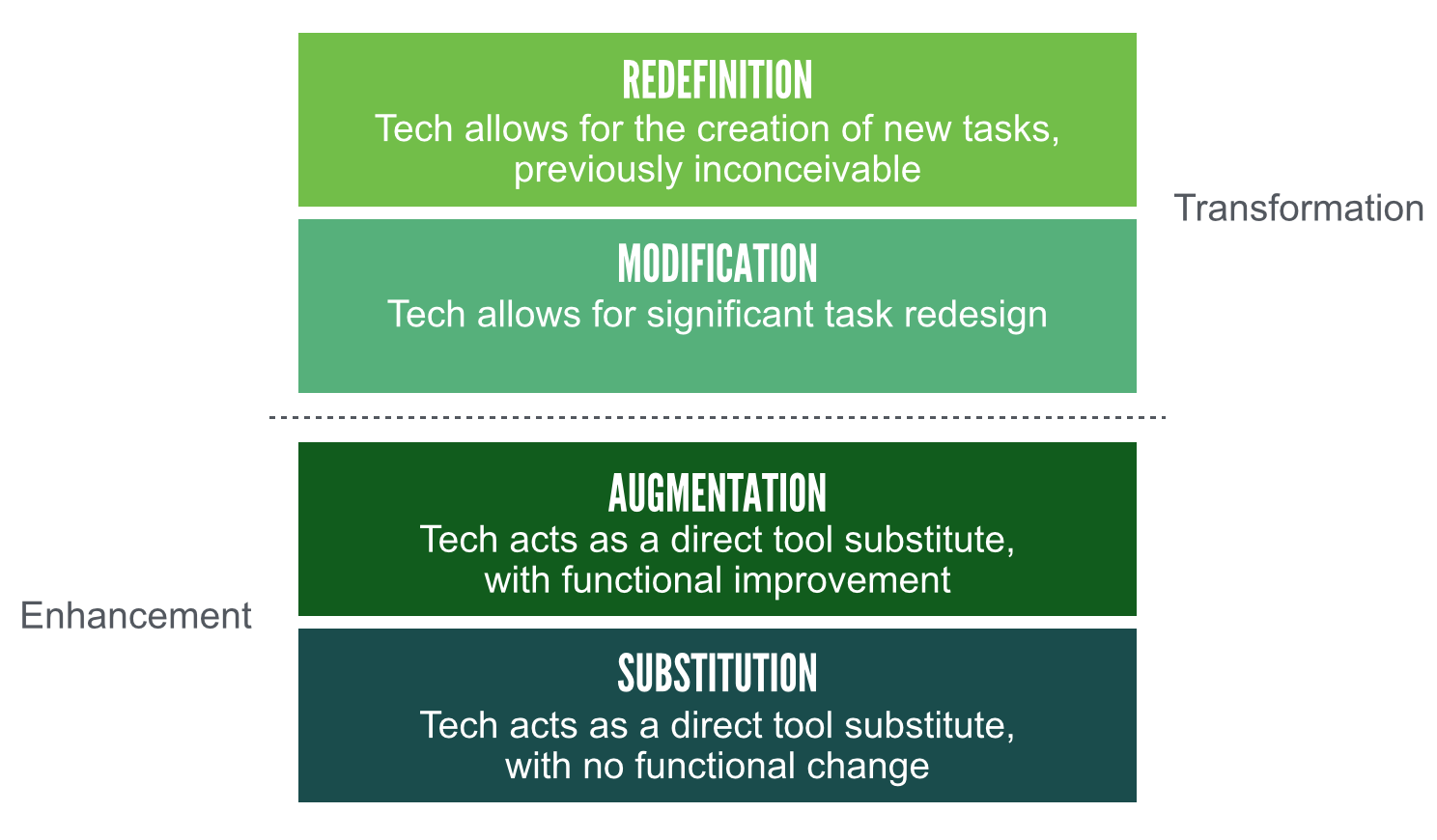
We’ve held thousands of conversations with charities, trusts and foundations, digital agencies and community groups discussing the opportunities and challenges of Generative AI (GenAI). One thing we’ve learnt is that the scale and speed of the changes means there are thousands more conversations to have (and much more action too). The reason is that there are many discussions, debates (and again, action!) to be had at multiple levels, because of the scale of the implications of GenAI.
Source: CAST Writers
Absurd design

We were using the CC0-licensed Humaaans for some work this week when the client decided they didn’t particularly like them. When searching for alternatives, I stumbled across Absurd Designs which doesn’t work any better, but which I’ve used for a couple of posts on my personal blog.
What about absurd illustrations for your projects? Take every user on an individual journey through their own imagination.
Source: Absurd Designs
TikTok as spectacle

Audrey Watters links to this post by Rob Horning which talks about sports, social media, AI, and Guy Debord. So pretty much catnip for me.
I’m just going to share the part about TikTok and Debord’s ‘spectacle’. It’s worth reading the rest of it for how Horning then goes on to apply this to LLMs such as GPT-4o and the semblance of doing rather than simply watching and consuming.
The way TikTok conflates experience with voyeurism makes it a somewhat clear demonstration of Guy Debord’s “society of the spectacle.” Debord argues that under the conditions of late 20th century capitalism — conditions of media centricity and monopoly that have only intensified into our century — spectacle and lived experience are in a complex dialectic that sustains a generalized alienation and a universal reification. “It is not just that the relationship to commodities is now plain to see, commodities are now all that there is to see; the world we see is the world of the commodity.” Debord concludes that individuals are “condemned to the passive acceptance of an alien everyday reality” and are driven to “resorting to magical devices” to “entertain the illusion” of “reacting to this fate.” TikTok could be considered as one of those magical devices (along with the phone in its entirety) that manages that dialectic. Under the guise of “entertainment,” passivity reappears to the entertained individual as a kind of perfected agency; alienation is redeemed as the requisite precursor to consumer delectation.
The way TikTok conflates experience with voyeurism makes it a somewhat clear demonstration of Guy Debord’s “society of the spectacle.” Debord argues that under the conditions of late 20th century capitalism — conditions of media centricity and monopoly that have only intensified into our century — spectacle and lived experience are in a complex dialectic that sustains a generalized alienation and a universal reification. “It is not just that the relationship to commodities is now plain to see, commodities are now all that there is to see; the world we see is the world of the commodity.” Debord concludes that individuals are “condemned to the passive acceptance of an alien everyday reality” and are driven to “resorting to magical devices” to “entertain the illusion” of “reacting to this fate.” TikTok could be considered as one of those magical devices (along with the phone in its entirety) that manages that dialectic. Under the guise of “entertainment,” passivity reappears to the entertained individual as a kind of perfected agency; alienation is redeemed as the requisite precursor to consumer delectation.
“The spectacle is essentially tautological,” Debord writes, “for the simple reason that its means and ends are identical. It is the sun that never sets on the empire of modern passivity. It covers the entire globe, basking in the perpetual warmth of its own glory.”
Source: Internal exile
The theory of 'a rising tide lifts all boats' does not work when you allow the people with the most influence to buy their way out of the water

I agree with this so much. I’ve had jobs where I’ve been entitled to private health insurance, which I’ve turned down because I want to have a stake in the success and continued existence of the National Health Service. I’d love a world where I don’t have to have a car because public transport is ubiquitous. I would never send my kids to private school, and am delighted that Labour have announced that, if they get into power, they’ll raise money for public schools from taxing private schools like the businesses they are.
One of the most direct ways to improve a flawed system is simply to end the ability of rich and powerful people to exclude themselves from it. If, for example, you outlawed private schools, the public schools would get better. They would get better not because every child deserves to have a quality education, but rather because it would be the only for rich and powerful people to ensure that their children were going to good schools. The theory of “a rising tide lifts all boats” does not work when you allow the people with the most influence to buy their way out of the water. It would be nice if we fixed broken systems simply because they are broken. In practice, governments are generally happy to ignore broken things if they do not affect people with enough power to make the government listen. So the more people that we push into public systems, the better.
Rich kids should go to public schools. The mayor should ride the subway to work. When wealthy people get sick, they should be sent to public hospitals. Business executives should have to stand in the same airport security lines as everyone else. The very fact that people want to buy their way out of all of these experiences points to the reason why they shouldn’t be able to. Private schools and private limos and private doctors and private security are all pressure release valves that eliminate the friction that would cause powerful people to call for all of these bad things to get better. The degree to which we allow the rich to insulate themselves from the unpleasant reality that others are forced to experience is directly related to how long that reality is allowed to stay unpleasant. When they are left with no other option, rich people will force improvement in public systems. Their public spirit will be infinitely less urgent when they are contemplating these things from afar than when they are sitting in a hot ER waiting room for six hours themselves.
Source: How Things Work
Image: Daniel Sinoca
Podcasts worth listening to

TIME has a list of the ‘best podcasts of 2024 so far’. 99% Invisible is great, but my favourite podcasts are nowhere to be seen on here, not to mention my own with Laura, The Tao of WAO! I love podcasts, and listen to them while running, in the gym, washing dishes, in the car, mowing the lawn… wherever,
You can download an OPML file (?) of all of the shows I subscribe via my Open Source app of choice, AntennaPod. My favourites at the moment though, in alphabetical order, are:
- Dan Carlin’s Hardcore History
- No Such Thing As A Fish
- The Art of Manliness
- The Rest is Politics
- You Are Not So Smart
It’s getting increasingly difficult to discover new treasures in the cacophonous world of podcasting. There are a lot of shows—many of them not good. It seems every week a new celebrity announces a podcast in which they ask other celebrities out-of-touch questions or revisit their own network sitcom heyday. And studios continue to scrounge for the most morally dubious true-crime topics they can find.
Source: TIME
Image: C D-X
65% of UK adults aged 18-35 support “a strong leader who doesn’t have to bother with parliamentary elections”

I wouldn’t usually link to UnHerd, but the figure quoted here is taken from a tweet by Rory Stewart, who I do trust. I’m hugely concerned about creeping authoritarianism, and so why I’m dead against the Tories, I can’t see how an even further-right party in the guise of Reform UK is something to be celebrated.
While I get the desire to have someone to sort things out, the way we do so is together using systems. Not by electing a tough-talking figurehead who dispenses with elections.
It is no wonder that, after a generation of Conservative Party rule, 46% of British adults now support “a strong leader who doesn’t have to bother with parliamentary elections”, a figure which rises to 65% of those aged 18-35. By Gove’s definition, the majority of the electorate will soon be composed of extremists: this widening gulf between the governing and the governed is not a recipe for political stability.
Source: UnHerd
Image: Cold War Steve
Oblivion doesn’t just mean eradication: it is erasure

If you haven’t come across the The New Design Congress before, I highly suggest reading their essays and research notes, and subscribing to their newsletter. The following is an excerpt from their most recent issue:
It is not only a gluttony for energy that animates Big and Small Tech, but also social legitimacy. Here, oblivion doesn’t just mean eradication: it is erasure. This manifests in the social burden of the so-called ‘unintended consequences’ of technology. There is much concern to hold regarding the deployment of digitised forms of identification, including so-called decentralised and self-sovereign ones. Feasible only at immense scale, their proposed reliance on power-hungry blockchains so susceptible to scams, frauds and wastefulness is but one issue. Digital identities sketch schizophrenic futures made of radical self-custody combined with naive market-based ecosystems of private identity managers. This assetisation is backed by a trust mechanism bound to become the mother of all social engineering attack vector, relying as it does on idealist claims of identity. If trustworthiness within a digital identity system can be defined as that which is necessary to permit access, it can also be defined as that which necessarily breaks security policies. In the US and UK, voter ID is already an efficient weapon for reactionary power structures to fight off democratic participation, particularly of minorities. No actors in the field has seriously reckoned with such socio-technical weaponisation of their tech stack.
As we etched in the previous Cable, another world is possible. One where new modes of self- and interpersonal recognition are developed from a posture of conciliation, rather than a fragile and vampiric extraction of socially-shared goods. The challenge now is sifting through the gold rush, to find systems that are capable of fulfilling this promise.
Source: CABLE 2024/03-05